Purpose-built stations up high, old farming villages lower down, and one big ski area joining them above the Tarentaise. Here is how the pieces fit and where to begin.
The ski area spreads over the south side of the Tarentaise, with roads and lifts climbing from Aime and the valley villages, and a cable car link across to Les Arcs. How these notes are kept.
La Plagne is less a single resort than a family of villages spread across one large ski area on the south side of the Tarentaise valley in Savoie. Some were built from scratch from the early 1960s onward, high up and close to the snow. Others are old farming villages lower down, where the lifts arrived later. They all share the same pistes, and on most days of the season you can ski from one to another without taking off your skis.
Two kinds of village
The high stations sit roughly between 1,800 and 2,100 m. Plagne Centre came first, a compact block with covered walkways so you can move around without stepping into the snow. Aime 2000 stands above it as one long building on a ridge. Plagne Bellecôte and Belle Plagne lie further up the main bowl, while Plagne Villages, Plagne Soleil and Plagne 1800 spread out in smaller, lower groups of buildings. These are the places where you walk out of the door and onto a piste.
Around the edges of the area, the older villages keep a different pace. Montchavin and Les Coches look across toward Les Arcs, Montalbert faces down over Aime, and Champagny sits in its own side valley to the south. They have wooden barns, small churches and village squares, and lifts tie them into the ski area. Further down still, valley villages such as Macot-la-Plagne offer a third choice: a quiet base off the slopes, with a drive or a bus up each morning.
The choice comes down to what you want from a day. The high stations give you the most dependable snow at the door. The lower villages give you trees to ski among when the light goes flat, and a place that still feels lived in after the lifts close.
Where beginners start
Most high stations have a gentle area right at the bottom of the village, often served by a few short lifts, where first-timers can learn without buying a pass for the whole area. Some of these lifts are free and some need a small pass; which is which changes from season to season. Once you can turn and stop, wide green and blue runs link the central villages, and you can follow them between Plagne Centre, Plagne Villages and Belle Plagne without meeting anything steep.
Lessons are on offer in every village. In the French school holidays classes fill early, so book well ahead if your dates fall then.
Next along the valley: The 1992 Olympic bobsleigh run
The high ground and the glacier
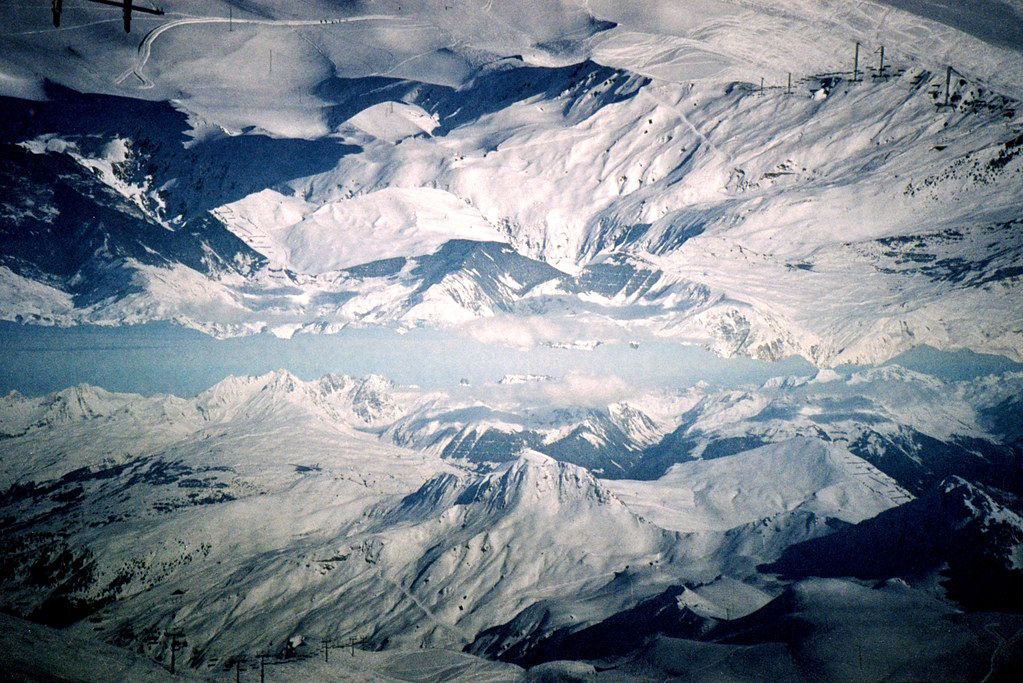
Above Belle Plagne, lifts climb toward the glacier slopes under the Bellecôte peak, the highest point around, at a little over 3,400 m. Up there the runs are long, the views reach far into the Vanoise, and the snow tends to hold well into spring. For many years the glacier was also skied in summer, but that has become irregular as the ice has thinned, so treat any summer skiing as a bonus to check on, not a plan.
Weather changes fast at that height. Wind can close the top lifts within an hour, and cloud can drop the light to almost nothing. Away from the marked pistes, the mountain is not patrolled or made safe, and the slopes around the glacier carry real avalanche and crevasse risk. Stay on marked runs, read the daily avalanche bulletin, and follow the advice of the ski patrol.
On the hillside below the high stations, the curves of the 1992 Olympic bobsleigh run are a reminder of the Games that brought new roads and new attention to the valley.
Passes and the link to Les Arcs
La Plagne is one half of Paradiski, a linked area that also takes in Les Arcs on the other side of the valley. The two are joined by a cable car link that spans the gap between the Montchavin side of La Plagne and Peisey-Vallandry on the Les Arcs side. It is a fast way across, but it can stop in high wind and has had long closures in the past.
Passes come in several forms: local passes for one village's lifts, passes for the whole of La Plagne, and wider passes that add Les Arcs. Prices, durations and the days on which the wider pass is included all change from year to year. Work out how much ground you will really cover; most beginners and many families never need more than the La Plagne area.
If you arrive by train, the station at Aime is the usual stop, with buses and the road climbing up to the stations from there.